Rust Workflows
This page shows workflows written in Rust. The model is the same as in JavaScript: read
Workflows and
Join Sets first. Rust workflows are
compiled to wasm32-unknown-unknown and run in Wasmtime. Like activities, their functions must
return a result type, see
Rust Activities.
Calling an activity
Continuing the fibonacci example from Rust Activities, the demo-tutorial Rust workflow is a complete buildable example. The project uses the following layout:
.
├── Cargo.toml
├── rust-toolchain.toml
├── src
│   └── lib.rs
└── wit
    ├── deps
    │   ├── obelisk_types@6.0.0
    │   │   └── types.wit
    │   ├── obelisk_workflow@7.0.0
    │   │   └── workflow-support.wit
    │   ├── template-fibo_activity
    │   │   └── fibo-activity.wit                   # Imported activity
    │   ├── template-fibo_activity-obelisk-ext
    │   │   └── activity-obelisk-ext.wit            # Generated -ext import
    │   └── template-fibo_workflow
    │       └── fibo-workflow.wit                   # Exported interface
    └── impl.wit                                    # World (imports and exports)
The activity interface, fibo-activity.wit:
package template-fibo:activity;

interface fibo-activity-ifc {
    fibo-activity: func(n: u8) -> result<u64>;
}
The workflow interface, fibo-workflow.wit:
package template-fibo:workflow;

interface fibo-workflow-ifc {
    fiboa: func(n: u8, iterations: u32) -> result<u64>;
    fiboa-concurrent: func(n: u8, iterations: u32) -> result<u64>;
}
The world, impl.wit, exports the workflow and imports the activity:
package any:any;

world any {
    export template-fibo:workflow/fibo-workflow-ifc;
    import template-fibo:activity/fibo-activity-ifc;
    import template-fibo:activity-obelisk-ext/fibo-activity-ifc;
    import obelisk:workflow/workflow-support@7.0.0;
}
wit-bindgen turns the exported interface into a Guest
trait and generates bindings for the imports. Calling an imported function blocks until the child
execution finishes:
impl Guest for Component {
    fn fiboa(n: u8, iterations: u32) -> Result<u64, ()> {
        let mut last = 0;
        for _ in 0..iterations {
            // Pause the workflow, submit a new activity execution and wait for the result.
            last = fibo_activity(n).unwrap();
        }
        Ok(last)
    }
}[[activity_wasm]]
name = "activity_myfibo"
location = "target/wasm32-wasip2/release/myactivity.wasm"
[[workflow_wasm]]
name = "myworkflow"
location = "target/wasm32-unknown-unknown/release/myworkflow.wasm"cargo build --release
obelisk server run --app-config app.toml --deployment deployment.toml
obelisk execution submit --follow \
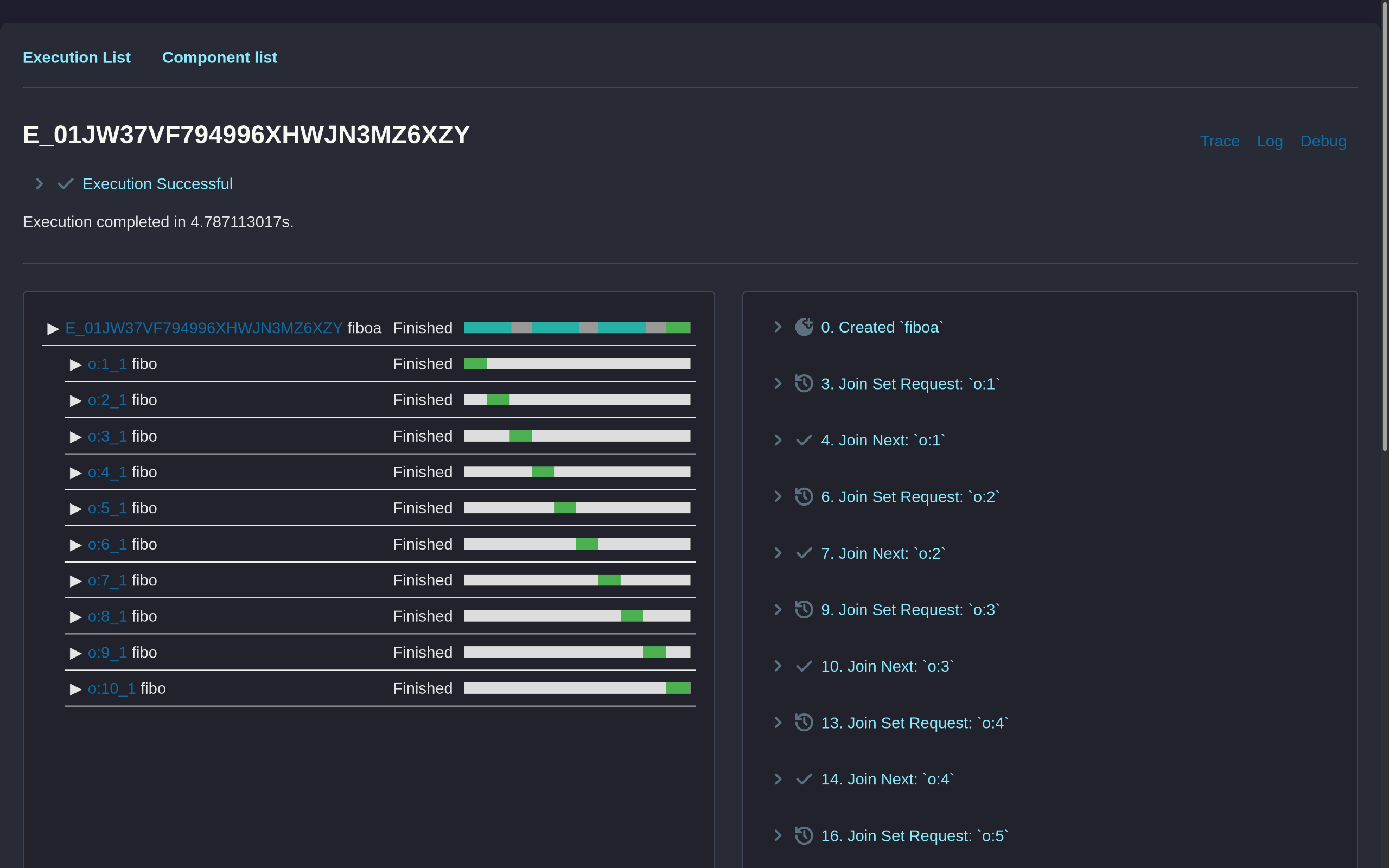
template-fibo:workflow/fibo-workflow-ifc.fiboa [40,10]The trace shows that the fibo activities were executed sequentially:
Submitting concurrently
The generated -obelisk-ext interface adds -submit, -await-next, and -get functions for every
imported function. See Extensions.
fn fiboa_concurrent(n: u8, iterations: u32) -> Result<u64, ()> {
    let join_set = join_set_create();
    for _ in 0..iterations {
        fibo_activity_submit(&join_set, n).unwrap();
    }
    let mut last = 0;
    for _ in 0..iterations {
        last = fibo_activity_await_next(&join_set).unwrap().unwrap();
    }
    Ok(last)
}
Join sets in Rust
let named = join_set_create_named("some-name").unwrap(); // See allowed join set characters
let generated = join_set_create();
Named join sets submitting two activities in parallel, from the stargazers demo:
fn star_added_parallel(login: String, repo: String) -> Result<(), String> {
    let description = db::user::add_star_get_description(&login, &repo)?; // one-off join set
    if description.is_none() {
        let join_set_info = join_set_create_named(&format!("{login}-info")).unwrap();
        let join_set_settings = join_set_create_named("settings").unwrap();
        account_info_submit(&join_set_info, &login);
        get_settings_json_submit(&join_set_settings);
        // `-await-next` returns the child result directly;
        // read `join_set.last_id()` if you also need the execution id.
        let info = account_info_await_next(&join_set_info).map_err(err_to_string)??;
        let settings_json = get_settings_json_await_next(&join_set_settings).map_err(err_to_string)??;
        let description = llm::respond(&info, &settings_json)?;
        db::user::update_user_description(&login, &description)?;
    }
    Ok(())
}
A heterogenous join set, mixing child executions and a delay, is awaited with join_next. Read
join_set.last_id() to learn which response was processed, then type the value with -get:
let join_set = join_set_create();
let execution_id_account = account_info_submit(&join_set, &login);
let _execution_id_settings = get_settings_json_submit(&join_set);
let _delay_id = submit_delay(&join_set, ScheduleAt::In(Duration::Seconds(10)));
match join_next(&join_set) {
    Ok(_result) => match join_set.last_id() {
        Some(ResponseId::DelayId(_)) => println!("delay won"),
        Some(ResponseId::ExecutionId(execution_id)) if execution_id.id == execution_id_account.id => {
            let resp = account_info_get(execution_id).expect("processed by join_next");
            println!("account-info response won: {resp:?}");
        }
        other => println!("settings or unexpected response won: {other:?}"),
    },
    Err(JoinNextError::AllProcessed) => unreachable!("submitted 3 child requests"),
}
join_next_try is the non-blocking variant, returning JoinNextTryError::Pending when no response
is available yet.
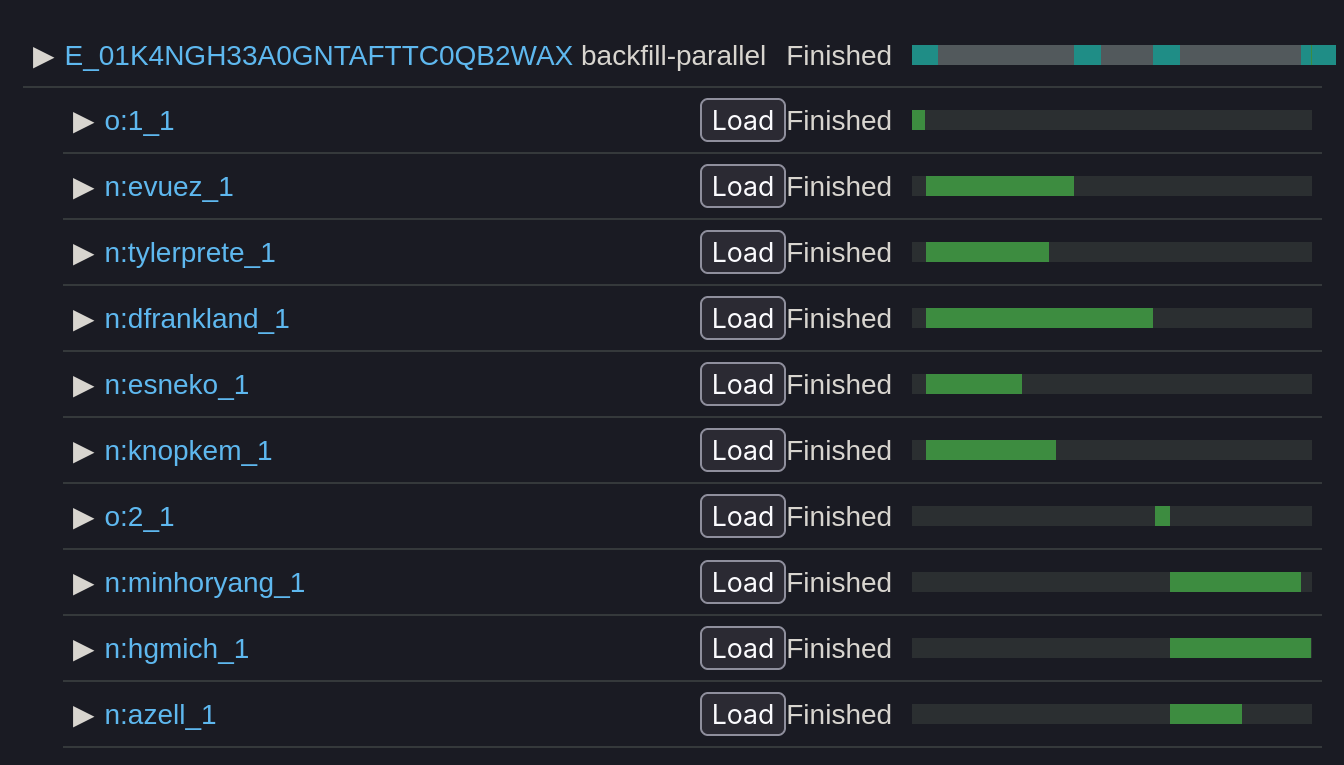
Join sets are closed with join_set_close, or automatically when the JoinSet value goes out of
scope. Dropping a batch of join sets at the end of a loop iteration therefore waits for their child
workflows, which adds back-pressure:
fn backfill_parallel(repo: String) -> Result<(), String> {
    let page_size = 5;
    let mut cursor = None;
    while let Some(resp) = github::account::list_stargazers(&repo, page_size, cursor.as_deref())? {
        let mut join_set_batch = Vec::new();
        for login in &resp.logins {
            let join_set = join_set_create_named(login).expect("valid join set name");
            star_added_parallel_submit(&join_set, login, &repo);
            join_set_batch.push(join_set); // closing the join set here would kill parallelism
        }
        if resp.logins.len() < usize::from(page_size) {
            break;
        }
        cursor = Some(resp.cursor);
        // `join_set_batch` is dropped here, awaiting all child workflows.
    }
    Ok(())
}
Persistent sleep
workflow_support::sleep(ScheduleAt::In(Duration::Seconds(10)), None)
    .map_err(|()| MyWorkflowError::Cancelled)?;
The trailing None optionally names the one-off join set. sleep returns an error if the delay is
cancelled. Use submit_delay to put a delay into a join set instead.
Scheduling
The -schedule function from the generated -obelisk-schedule interface starts a top-level
execution without awaiting it:
fn schedule_child(n: u8) {
    fibo_activity_schedule(ScheduleAt::In(Duration::Minutes(5)), n).unwrap();
}
Backtrace sources
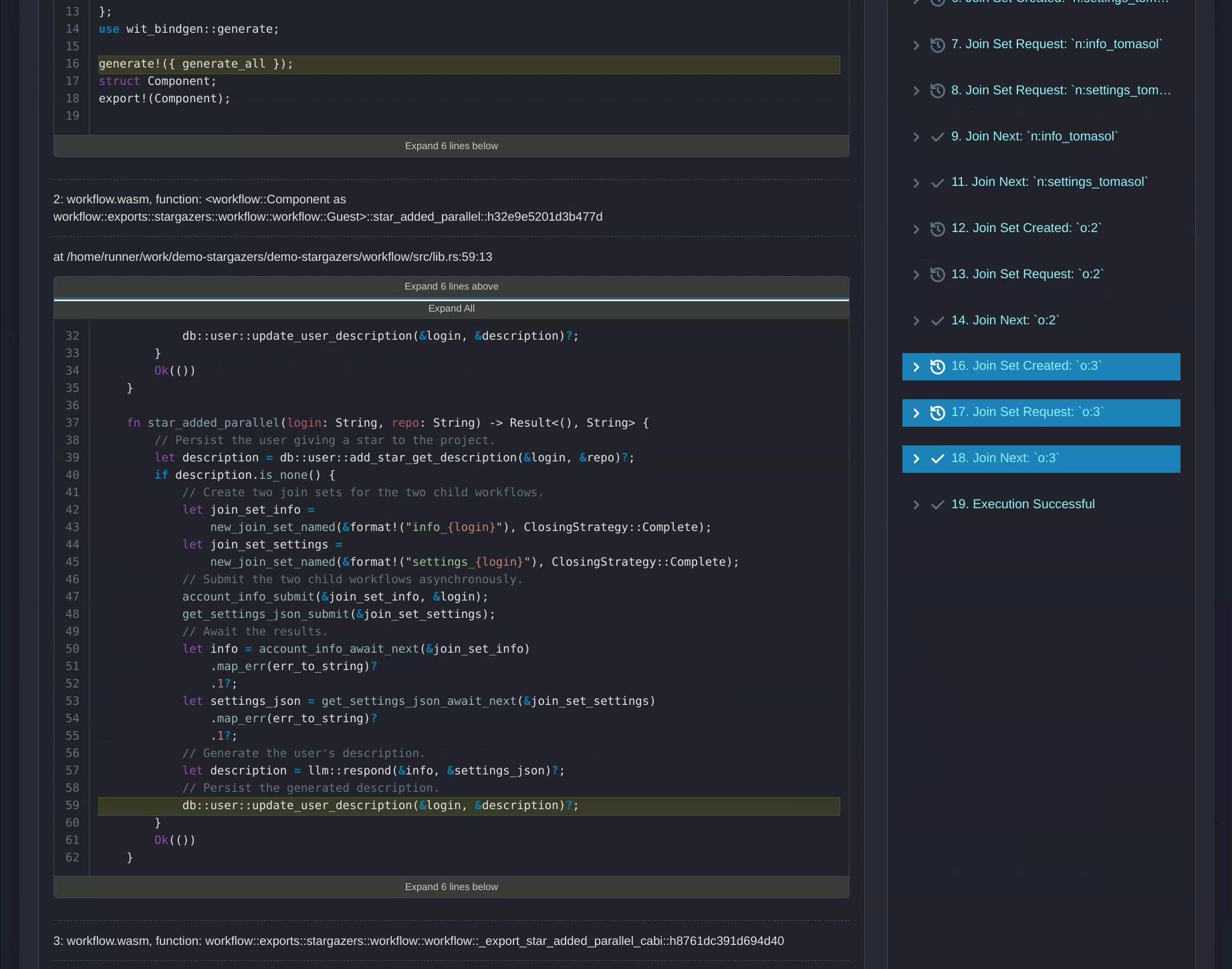
Workflow backtraces are captured lazily during user-issued replay and advance operations. If
backtrace.sources is set, the Web UI can display the source file and line of every captured frame:
[[workflow_wasm]]
backtrace.sources = {".../src/lib.rs" = "workflow/src/lib.rs"}
The mapping is from frame source to the local file system. When .../ is used, the frame source
path is matched by suffix, src/lib.rs in this example. To replay an execution and persist its
call-site backtraces, run:
obelisk execution persist-backtraces <execution-id>